
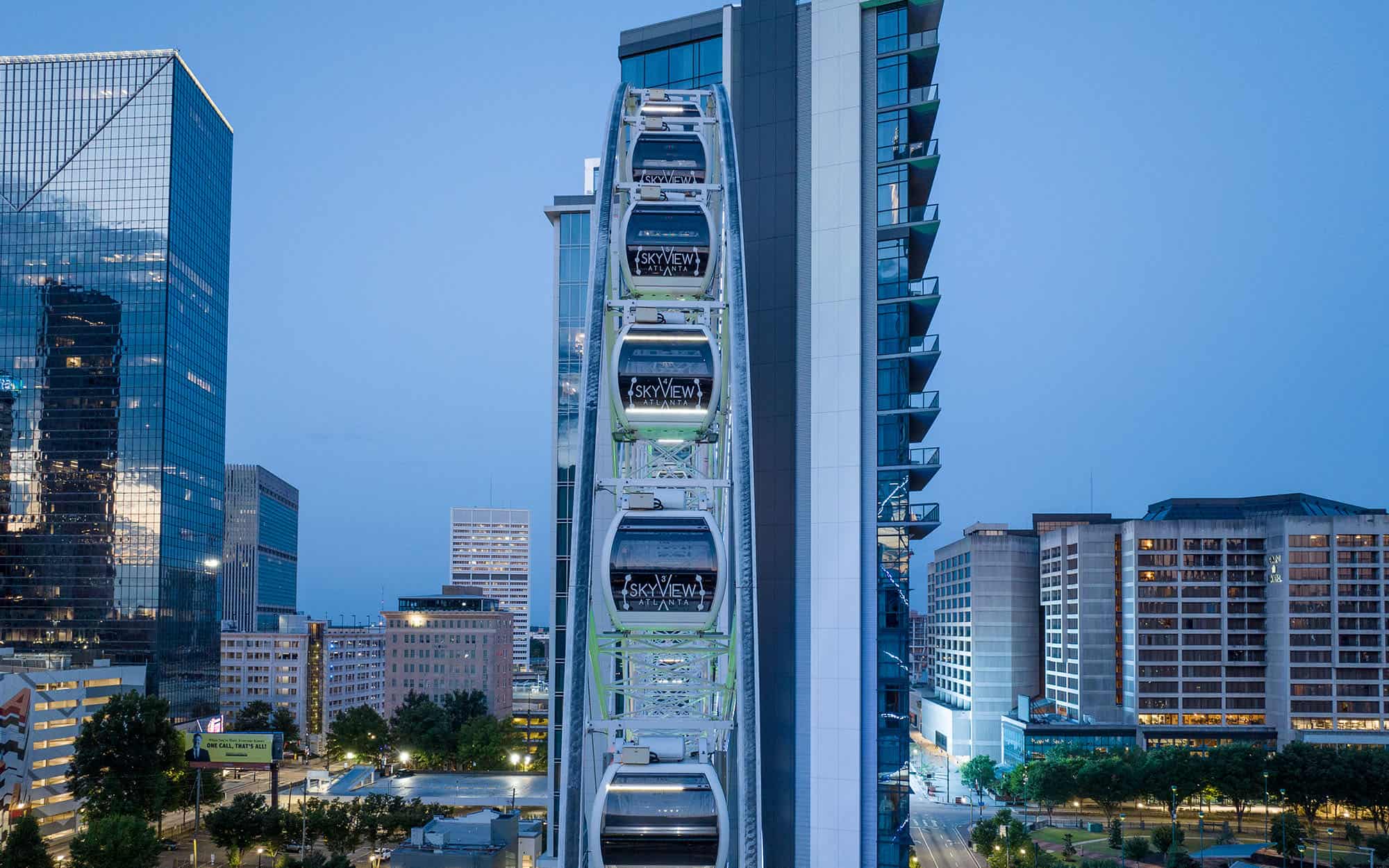
A single ride 200 feet above Centennial Olympic Park hands students math, engineering, geography, and art lessons they can trace straight back to a standard, not just a scenic break from class. On a SkyView Atlanta field trip, every one of those lessons comes from a printed study guide matched to Common Core, the C3 Framework, NGSS, or the Georgia Standards of Excellence, giving teachers the exact citation a principal or budget committee wants to see before signing off.
The Study Guides Behind a SkyView Atlanta Field Trip
Observation wheel learning starts on paper long before a single gondola loads. Every field trip starts with the two study guides SkyView Atlanta built specifically for classrooms, one for grades 3 to 5, one for grades 6 to 8, each carrying six interdisciplinary lesson plans and a teacher instruction page that names the objective and the exact standard it satisfies. The wheel that carries those lessons rises 200 feet directly across from Centennial Olympic Park, and the origin of that structure gives useful context before a class ever boards. Questions that usually surface during a planning meeting, from accessibility, weather policy, and what happens if a date needs to move, get settled well before a teacher picks up the phone. Among Atlanta field trips for students, few come with lesson plans written by the same people who operate the attraction.
The Ride Itself Turns Into a 12-Minute Lesson
The learning does not wait for a worksheet or a bus ride home. From the moment gondolas start loading, the ride itself becomes the lesson, and a full class moves through it in staged groups rather than all at once. SkyView Atlanta breaks a class into small gondola groups so no student rides unsupervised, a system built to scale past a typical family visit, and a teacher managing a full grade level can check how that grouping handles a much larger headcount. Chaperone ratios, boarding order, and how a single ride folds into a longer day downtown all shape how smoothly the actual visit runs once the bus pulls up. Students riding closer to golden hour watch the skyline catch a kind of light that turns their souvenir photos into their own art lesson, the same kind of shot that fills the wheel’s public gallery.
Math and Geometry From 200 Feet Up
Numbers stop being abstract once a student is the one doing the measuring. The elementary guide has younger riders estimate the wheel’s diameter by comparing it to nearby buildings, then check that estimate against the real number once they’re back at their desks. Middle schoolers go further, calculating the circumference of a full rotation and using the timed ride length to work out angular speed, the same kind of problem that usually lives only in a textbook diagram. Because the wheel is a fixed, verifiable structure rather than a hypothetical shape on a worksheet, the math holds up to a follow-up question in a way a diagram never quite does.
Engineering and Physics in the Wheel’s Own Mechanics
A 200-foot structure spinning a full loop turns any Atlanta STEAM field trip into a working demonstration of force and load. Riders feel the shift in gravity and momentum as the cabin climbs and levels off, and the study guide’s engineering equations turn that sensation into a lesson on the forces holding a tall structure upright and moving. Middle school students work through how engineers distribute weight across the frame and cables, the same balance-of-forces question that shows up later in a high school physics unit. Elementary students get a simpler version, tracking how the wheel’s motor keeps a steady, predictable speed no matter how many gondolas are loaded.
Geography and Social Studies From a Skyline Map
A skyline only becomes a map once a student can name what they are looking at. From the top, Atlanta’s grid, its stadium, and Centennial Olympic Park line up the way they never do on a printed map, and the guide’s seek-and-find activities have students identify landmarks and trace how downtown grew up around the 1996 Olympics, tying directly into the C3 Framework’s expectations for geographic reasoning and local history. Younger students practice basic map orientation and directionality, while older students connect what they see to the civic and historical context behind why the city looks the way it does.
Art and Visual Design at the Top
The skyline itself becomes the subject matter once cameras come out. Composition, framing, and perspective are hard to teach from a slide, but a moving gondola gives students a real vantage point to practice all three, whether they’re sketching the skyline in a notebook or lining up a shot on a phone. The crossword and seek-and-find pages in the printable STEAM packet reinforce vocabulary around design and structure, giving art teachers a way to fold the visit into a broader unit on architecture or urban design without inventing new material from scratch.
Field trip pricing runs seasonal and reservations need at least a week of lead time, so pin down your date and headcount before the rest of your school year fills your calendar.
Turning a SkyView Atlanta School Trip Into a Before, During, and After Lesson
The study guide is built to stretch a SkyView Atlanta school trip past the 12 minutes actually spent on the wheel. Teachers who send the guide home or project it before the trip prime students to look for what the lesson calls out once they’re in the gondola, and a quick worksheet review the same afternoon locks in vocabulary before it fades by Friday. Bus logistics matter here too. Drivers coordinating pickup and drop-off can confirm entrance and staging near the Luckie Street entrance well before the bus leaves the lot, and a class with an hour to spare can extend the outing by walking through what else sits within a few blocks of Centennial Olympic Park rather than heading straight back to school.
What a SkyView Atlanta Field Trip Costs to Put in a Budget Request
Cost is usually the first question an administrator asks, and it is an easy one to answer here. Field trip tickets run $10 per student and $10 per chaperone during the school year, and the teacher or group leader who organizes the trip rides free, so the only real budget line is a flat per-student rate with no hidden add-ons for the study guides themselves. That rate sits well below general admission ticket pricing and holds from August through May, lining up with the school calendar instead of requiring a separate summer rate check. Because the standard field trip ticket already includes the printed materials, a teacher can hand a principal one number and one date, the two things most approval forms actually ask for.
SkyView Atlanta Turns a School Trip Into a Standards-Aligned Lesson
A field trip earns its permission slip when it can point to something more than a fun afternoon, and a ride on SkyView Atlanta hands a teacher exactly that: math a student can verify, engineering they can feel, geography they can trace with their own eyes, and art they can frame themselves, all matched to a standard a district already teaches toward. The wheel sits close enough to Centennial Olympic Park that none of it requires a special trip across town, and the study guides mean the learning keeps going well after the bus pulls away.
For a class that needs the numbers to work and the standards to hold up, educational field trips Atlanta rarely come packaged this specifically, with per-student pricing, standards-cited lesson plans, and a view of the whole city built into one trip. A quick message with a preferred date and headcount is enough to start the conversation.